Monday, 27 January 2014

What lies beneath Piazza Navona


How many times have we all criss-crossed Piazza Navona, one of the most popular spots for visitors to Rome, without thinking about the layers of history that lie beneath its beautiful fountains, its cobblestones and concrete benches, buskers and vendors?

Well, it has now become easier to get a glimpse of its long history, as a small section of the original structure built there - the Stadium of Domiziano - has been opened to the public.

I visited it on Sunday with my friend and classics scholar Laura, who explained in great detail the origins of the site which was completed in about the year 86 by the mad emperor Domiziano for a great athletic event in honour of the god Jove.

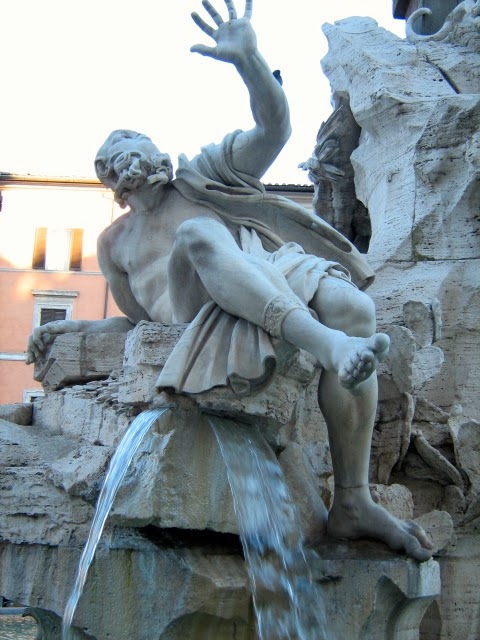
(The photos below are from Bernini's great Fountain of the Four Rivers in the centre of today's Piazza Navona)

Laura explained that there are some misconceptions about the origins of the stadium that shaped today's Piazza Navona, including the fact it was, indeed, a stadium for athletic events and not a circus, like Circus Maximus, which was used for larger events such horse and chariot races. It was also interesting to learn that a stadium was originally a unit of measure that varied depending on where it was used. In Latin it often referred to 176 meters, the length of a particular foot race.

The Stadio di Domiziano was the first permanent athletic structure in Rome - previously, temporary venues were built, perhaps from wood - and this stadium was modelled on the style used in Greece. Looking at a modern reconstruction, it stuck me how similar it is to many sports stadiums I have seen in North America!


The stadium originally seated about 30,000 spectators and the shape of Piazza Navona almost exactly follows the sweep of the original oval structure, which included a beautiful marble viewing box for the emperor and other nobility on the spot where today's church of Sant'Agnese in Agone rests.

In fact, there is a connection here with the young Saint Agnes. Apparently, brothels had originally been established in certain arcades of this stadium structure, and it was in one of these where Agnes's martyrdom began, because she refused to marry as ordered by a later emperor, Diocletian. (Another small fact, the word "fornicate" is derived from the Latin name of the arch of an arcade, "fornix,"  according to Laura).

Still another fun fact, the word "Navona" as used in Piazza Navona, is derived from the term "agonalis" a combined Latin-Greek word for "struggles" describing the athletic competition in the original stadium….and over the years, was mispronounced until it became "Navona" (which, frankly, sounds better to me!)


Sunday, 19 January 2014

A January Sunday in Rome.

As a girl from the Canadian Prairies, I am still gobsmacked by the sight of Rome in January, and just how very green everything is….even a few wild flowers are pushing  their way through the hard soil of the Roman Forum.


How I love the sight of lemon tress and their bright fruit!


It was a bit cloudy as I made my way up the Capitoline Hill …


I felt sad to see that the gardeners of Rome's capitol hill have not been taking care of the delightful topiary figures of the iconic she-wolf, feeding babies Remus and Romulus (who now look like shaggy little shrubs)


Of course, I can never resist this shot of the Palatine Hill, from across Circus Maximus.


Friday, 3 January 2014

Return to Rome's Monti neighbourhood


I'm happy to report that I am once again living in Rome's Monti area, where I lived for almost all of 2012. It's a great neighbourhood, snugged in beside the Imperial Forum which runs alongside the Roman Forum, divided only by the major Via dei Fori Imperial.


In fact, the western edge of Monti, known in ancient times as Subura, is formed by a high stone wall along Via Tor de’ Conti, which follows the contours of the forums of Augustus, Vespasian, Trajan, and Nerva.


The wall was built to protect Imperial Rome from the ancient slum, where Julius Caesar is said to have grown up.

Indeed, Monti remained a rather rough, unpopular neighbourhood until Rome became the capital of a united Italy in 1871.


I moved back in to Monti just in time to see the Christmas tree still set up in front of the Colosseum, now undergoing some restoration work and partly hidden under scaffolding. 

The holiday tree will likely be removed right after the January 6 Epiphany holiday.


After hearing of the terrible snowstorms that people in Canada and parts of the United States have been facing in these first few days of January 2014, I am doubly thrilled to see lots of green grass around here.


Sunday, 22 December 2013

Christmas in Rome


This will be my third Christmas living in Rome, and I am developing a few favourites, especially the lovely Christmas lights, and the massive holiday tree in Piazza San Pietro at the Vatican.


For a chance of pace, a Christmas tree in the piazza San Lorenzo in Lucina seems to be decorated with movie film and is sitting on a giant film reel - perhaps in honour of the former Etoile cinema in the square that is now a very large and beautiful Louis Vuitton store (which runs old movies in the store in honour of its origins as a cinema.)


I really love Christmas lights!


On Rome's central Via del Corso, the lights this year are decorated in the colours of the Gay Pride flag (which caused some controversy on city council!) 


Meanwhile, as I was walking around the Vatican today, to see how Christmas preparations were going, I took a few photos from outside the rear walls of Vatican City.


Buon Natale!

Tuesday, 3 December 2013

A December evening in Rome


When I heard this week that the cleaning of Bernini's Fontana del Tritone in Piazza Barberini had been completed, I strolled over there after work to see it for myself. It really looks lovely!


Triton was a minor sea god and here he is shown as a kind of merman, head thrown back as he drinks from a conch shell.

I especially enjoy the depictions of dolphins in Renaissance and Baroque-era sculpture, as some kind of vicious sea creature with sharp teeth and menacing expressions.


Interestingly, there was also a very large, metal Menorah in the Piazza celebrating Hanukkah.


And, as I walked home I noticed that more and more businesses on my street are putting up pretty little Christmas decorations and pine boughs around their doors.


Saturday, 30 November 2013

Marking my second anniversary of life in Rome


The other day I was riding an escalator and became so engrossed in conversation with my friend Stefania, who was one step below me, that I forgot where I was and when the moving stairs reached the top, I pitched backwards, arms windmilling frantically before I fell flat on my back. My biggest concern was that my pant leg would get caught in the machinery and rip the fabric right off my backside - THAT would be mortifying.

So, I jumped right up and then I had to laugh at how clumsy I am.

Today as I mark the two-year anniversary of the day I moved from Canada to Rome, I really think that this has been the most important thing that I have learned, and re-learned, and re-learned again: how crucial it is to maintain a good sense of humour; and how crucial it is to be able to laugh at myself.


Life in Rome is full of complications and challenges - like life anywhere, I suppose. But living in a new culture and a new language adds a few extra layers in complexity and I devote a fair amount of effort to learning to navigate these. Happily, I have mostly done better in life than I did on that escalator.

I continue struggling to find a place to settle and perhaps it was fitting that today, on my anniversary, I marked the occasion by finding a new apartment - my 5th since arriving here! I am excited to be returning to the Monti area where my first two apartments were located and which is my favourite quartiere in Rome.

The apartment itself is extraordinarily small (above is the view if I lean way out the window) but since one of my goals in moving to Italy was to find a more simple, pared down life while enlarging my emotional and intellectual self, I suppose it fits. Plus, it has a full-sized fridge, no mean thing.

I have made some wonderful new friends in Rome, including Michele who owns a fantastic art gallery, RvB Affordable Art near Piazza Farnese. I popped in to snag her for a quick lunch at Zoc's which is charming. I had ravioli stuffed with pumpkin.


Then, time to run errands which I seem to do a lot in Rome. However, it is certainly more beautiful to do so here, when I can take shortcuts such as today's through the courtyard of the Museo di Roma in Palazzo Braschi where there was an interesting outdoor display of sculpture:


I emerged in Piazza Navona where booths are being set up for the Christmas mercato. This will be my third Christmas in Rome and unfortunately, I have seen that the market has become dominated by cheap imported trinkets that push out more authentic Italian goods and spoil the effect. Alas.


Still, no matter how tawdry some elements of life here can be, these cannot undermine the great and sometimes surprising magnificence of Rome!


Monday, 25 November 2013

Autumn in Umbria


Living in Rome is often an adventure and always interesting, but sometimes it is a great relief to get out of town to visit the region of Umbria, which I consider to be my sanctuary.

My dear friend Mary took me on some lovely roads recently to enjoy the fall colours and an incredible lunch in a fantastic, rustic restaurant called Serpillo in the tiny bongo of Torre del Colle.


It sits atop a hill looking down on the delightful town of Bevagna.


Mary explained that the red vines blanketing some fields so beautifully are the remains of the noble Sagrantino, source of such great Umbrian wines.


Most of the olives have now been picked and pressed into wonderful oil - I especially love Umbrian olive oil. I am excited to try Mary's Genius Loci oil this year, only a few days old!